 Back (Grenade Page)
|
With the elimination of the Type 91 as a multi-purpose hand grenade / mortar round, the Japanese introduced a hand / rifle grenade combination. The Type 99 Grenade and the Type 100 Cup Discharger.  The fuze is a percussion delay, as with the 91 & 97 Types. It is operated by removing the safety pin and hitting the cap hard to start the delay. Earlier Type 99's had a paper instruction label with graphics and text showing its use. The fuze on this one is dated May 1942. (Follow the "Blue Dot" link at the bottom of the page.) |
The Type 99 fuze is distinctly different from its predecessors. |

|
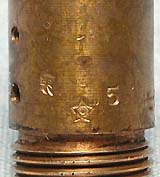
Kanji symbol for "Arsenal" The star logo = 1st Tokyo Army Arsenal followed by 7 (off screen) 10 Showa "May 1942" |

Crossed cannons logo for the Osaka Army Arsenal.
Japanese dates are read right to left on grenade fuzes. The first character on the right is "Showa" then 10 and 8 (Hirohito's 18th year), which is 1943 on our calendar. The "6" indicates June. |
Back (Grenade Page)


